Wheels and tires |
Wheels and tires
The handling and riding comfort of the vehicle is dependent on the inflation pressure and the type of tires fitted. Read the following pages carefully.
| pg. 66 | General |
| pg. 67 | Tread wear indicators |
| pg. 68 | Inflation pressures |
General information
Your vehicle is equipped with 6 x 15 or 6.5 x 16" wheel rims.
In other words the width of the wheel rim is 6 inches and its diameter 15 inches.
The tire designation is coded as follows:
185 or 205 = tire width in mm.
65 or 55 = tire profile. This is the relationship (in percent) between the section height and the width of the tire.
R = radial tires.
16 = suitable intended rim size.
The tires have good road holding characteristics and offer good handling on dry and wet surfaces. It should be noted however that the tires have been developed to give these features on snow/ice-free surfaces. For optimum road holding on icy or snow covered roads - we recommend suitable winter tires.
When replacing tires, be sure that the new tires are the same size designation, type (radial) and preferably from the same manufacturer, on all four wheels. Otherwise there is a risk of altering the car's road-holding and handling characteristics.
NOTE: When storing wheel/tire assemblies (e.g. winter tires and wheels), either stand the assemblies upright, or suspend them off the ground. Laying wheel/tire assemblies their sides for prolonged periods can cause wheel and/or tire damage.
Wear indicator
The tires have a so-called "wear indicator" in the form of a number of narrow strips running across or parallel to the tread. When approx. 1/16" (1.6 mm) is left on the tread, these strips show up and indicate that the tire should be replaced.
Tires with less than 1/16" (1.6 mm) tread have a very poor grip in rain or snow.
When replacing worn tires, it is recommended that the tire be identical in type (radial) and size as the one being replaced. Using a tire of the same make (manufacturer) will prevent alteration of the driving characteristics of the vehicle.
To improve tire economy:
∙ Maintain correct tire pressure.
∙ Drive smoothly: avoid fast starts, hard braking and tire screeching.
∙ Tire wear increases with speed.
∙ Do not change wheel location unless necessary.
∙ Correct front wheel alignment is very important. Unbalanced wheels impair tire economy and driving comfort.
∙ Unbalanced wheels impair tire economy and driving comfort.
∙ Hitting curbs or potholes can damage the tires and/or wheels permanently.
Flat spots
All tires become warm during use. After cooling, when the vehicle is parked, the tires have a tendency to distort slightly, forming flat spots. These flat spots can cause vibrations similar to the vibrations caused by imbalanced wheels.
They do, however, disappear when the tire warms up. The degree to which the flat spots form depends on the type of cord used in the tire. Remember that, in cold weather, it takes longer for the tire to warm up and consequently longer for the flat spot to disappear.
Snow tires, studded tires *
Tires for winter use:
Use snow tires fitted to the standard 15" wheels (preferably steel).
Suitable tire size: 185/65 TR (motor B230F, on all four wheels) or 195/60 HR (Turbo, on all four wheels). No rims from other Volvo models can be used on the 740.
Do not mix tires of different design, as this could negatively affect overall tire road grip especially during slippery road conditions!
Studded tires should be run-in 300-600 miles (500-1000 km) during which the car should be driven as smoothly as possible to give the studs the opportunity to seat properly in the tires. The car tires should have the same rotational direction throughout their entire lifetime. In other words, if you wish to rotate the wheels, make sure that the same wheels are always on the same side of the car.
Tire
chains
can only be used on the rear wheels if the chains do not project too far from the tire and chafe against the brake caliper or other components.
Strap-on emergency chains must not be used
since the clearance between the brake caliper and the wheel rim is inadequate.
WARNING!
|
Checking and correcting tire pressure
Check the tire pressure when refueling.
The tire pressure should be corrected only when the tires are cold. With warm tires, correct only when the pressure is too low. The tire temperature rises after driving just a few miles.
Vehicle Loading
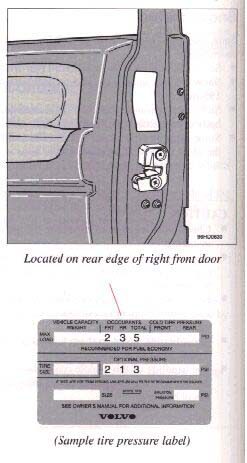
The tires on your Volvo will perform to specifications at all normal loads when inflated as recommended on the tire information label located on the rear facing side on the right front door. This label lists both the tire and vehicle design limits.
Do not load your car beyond the load limits indicated.
NOTE: This label is a sample. See label on your car for correct data. |

