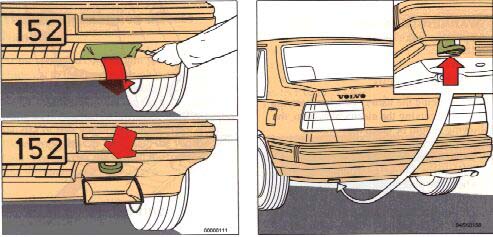
Front eyelet Rear eyelet
Precautionary steps to observe when car is in tow
∙ Steering must be unlocked.
∙ Please check with state and local authorities before attempting this type of towing, as vehicles being towed are subject to regulations regarding maximum towing speed, length and type of towing device, lighting, etc.
∙ Remember that power brake and power steering assists will not be available when engine is inoperative. Brake pedal pressure required is 3 - 4 times above normal and greater steering effort must be exerted.
∙ Gear selector in position N. Check transmission oil level (see section titled "Transmission oil").
If battery is dead, the gear selector must be released from the P position manually. See page 6:18 for instructions.
∙ Maximum speed: 20 mph (30 km/h).
∙ Maximum distance with rear wheels on ground: 20 miles (30 km).
Cars equipped with automatic transmission/catalytic converters cannot be started by pushing or pulling
the car.
CAUTION: The towing eyelets must not be used for pulling another vehicle out of a ditch or any similar purpose involving severe strain. |
Only use wheel lift or flat bed equipment.
CAUTION:
|
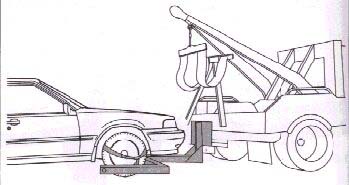
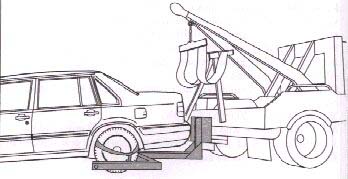
CAUTION:
|
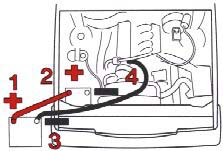
Check that cars are touching to prevent premature completion of negative circuit. Note the position of the battery terminals and using jumper cables:
∙ First connect booster battery positive (+) terminal (1) to car battery positive (+) terminal (2).
∙ Then connect booster battery negative (-) terminal (3) to a stationary solid metal part on the engine at a point away from the battery (4).
Do not connect booster cable to any part of fuel system or any moving parts. Avoid touching hot manifolds.
∙ After engine has started, remove first the negative (-) terminal jumper cable. Then remove the positive (+) terminal jumper cable.
WARNING!
|
Catalytic converter cautions
∙ Keep your engine properly tuned. Certain engine malfunctions, particularly involving the electrical, fuel or distributor ignition systems, may cause unusually high three-way catalytic converter temperatures.
Do not continue to operate your vehicle if you detect engine misfire, noticeable loss of power or other unusual operating conditions, such as engine overheating or backfiring. A properly tuned engine will help avoid malfunction that could damage the catalytic converter.
∙ Remember that tampering or unauthorized modification to the engine or the vehicle may be illegal and can cause three-way catalytic converter or exhaust system overheating. This includes:
Altering fuel injection settings or components. Adjusting distributor ignition timing beyond specified limits.
Altering emission system components or location or removing components
Repeated use of leaded fuel.
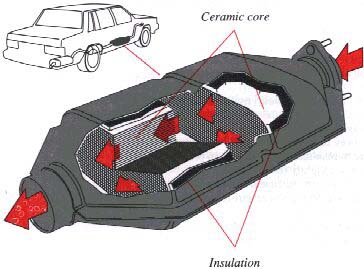
∙ Do not park your car over combustible materials, such as grass or leaves, which can come into contact with the hot exhaust system and cause such materials to ignite under certain wind and weather conditions.
∙ Excessive starter cranking (in excess of one minute), with an intermittently firing or flooded engine, can cause catalytic or exhaust system overheating.
NOTE: Unleaded fuel is required for cars with three-way catalytic converters. A label on the instrument panel and inside fuel tank filler door will remind owners and filling station attendants of this requirement.
|

If one of the brake circuits should malfunction, the red warning light will come on. (see page 8)
The pedal stroke increases slightly, the pedal feels softer and on cars equipped with ABS, extra pressure is required for normal braking.
On vehicles not equipped with ABS extra pressure is not generally required for normal braking even if there is a malfunction in one of the brake circuits.
If the light comes on while driving or braking: stop immediately, open the hood and check the brake fluid level in the reservoir (see "Brake fluid, power steering" section).
WARNING!
|
If the fluid level is below the MIN mark in half of the reservoir: Drive carefully to a garage and have the brake system checked.
Moisture on brake discs and brake pads affects braking.
Driving in rain and slush or passing through an automatic car wash can cause water to collect on the brake discs and pads. This will cause a delay in braking effect when the pedal is depressed. To avoid such a delay when the brakes are needed, depress the pedal occasionally when driving through rain, slush etc. This will remove the water from the brakes. Check that brake application feels normal. This should also be done after washing or starting in very damp weather.
Severe strain on the brake system
The brakes will be subject to severe strain when driving in mountains or hilly areas. The speed is usually low which means that the cooling of the brakes is less efficient than when driving on level roads.
To reduce the strain on the brakes it is advisable not to use the brakes excessively.
Instead, shift into a lower gear and let the engine help with the braking. A good rule is to use the same gear downhill as would be used ascending the same grade. For vehicles with automatic transmission use position 2 or, in some cases, 1.
Do not forget that, if you are towing a trailer, the brakes will be subjected to greater load than is normal.
Breaking-in parking brake (hand brake)
To obtain the best parking brake performance, the brake linings should be broken-in.
Stop 5-7 times from 30 mph (50 km/h). transmission in neutral, applying the parking brake with the release button pressed in during the stop.
The force must not lock the rear wheels. If this happens, rotate the brake enough to let the wheels rotate. Drive a mile between each stop to cool the brakes. Check for proper parking brake operation.
WARNING!
|
If the brake power-assist does not function
The power assist to the brakes functions only when the engine is running.
When the car is moving without the engine running the brake pedal pressure required to stop the car is increased by 3-4 times.
The brake pedal feels stiff and hard.
When preparing for trailer hauling, observe the following:
∙ Use a trailer hitch which meets Federal Safety Standards for rear end collisions (FMVSS 301-75) For trailer weights exceeding 2000 lbs. (908 kg), use only a trailer hitch offered as a Genuine Volvo Accessory. Since the automatic transmission is subject to increased load and temperature, certain vehicles are equipped with an extra oil cooler as standard equipment. Consult your Volvo dealer for further information.
∙ Maximum trailer weight recommended by Volvo is 3300 lbs (1500 kg). Observe legal requirements of the state in which the vehicles are registered.
All Volvo models are equipped with energy-absorbing shock-mounted bumpers. Trailer hitch installation should not interfere with the proper operation of this bumper system.
Trailer towing does not normally present any particular problems, but take into consideration:
∙ Increase tire pressure to recommended load pressure. See section "Wheels and tires".
WARNING! Never connect a trailer's hydraulic brake system directly to the vehicle brake system, nor a trailer's lighting system directly to the vehicle lighting system. Consult your nearest authorized Volvo dealer for correct installation. |
WARNING! Bumper-attached trailer hitches must not be used on Volvos, nor should safety chains be attached to the bumper. Trailer hitches attaching to the vehicle rear axle must also not be used. |
∙ Recommended hitch tongue load is 165 (75 kgs) for trailer weights above 2,650 lbs (1,200 kgs) and 143-154 lbs (65-70 kgs) for trailer weights below 2,650 lbs (1,200 kgs).
However, the hitch tongue load should not exceed 200 lbs (90 kgs).
∙ For trailer weights between 2,650-3,300 lbs (1,200-1,500 kgs) a top speed of 50 mph (80 km/h) should never be exceeded.
∙ Engine and transmission are subject to increased loads. Therefore, engine coolant temperature should be closely watched when driving in hot climates or hilly terrain. Use lower gear and turn off air conditioner if temperature gauge pointer enters the red range.
∙ Disengage the overdrive on models with automatic transmission
∙ Avoid overload and other abusive operation.
∙ Hauling a trailer affects handling, durability, and economy.
∙ It is necessary to balance trailer brakes with the towing vehicle brakes to provide a safe stop. Check and observe State/Local regulations.
∙ More frequent vehicle maintenance is required.
∙ Remove the ball and drawbar assembly when the hitch is not being used.
NOTE: Refer to section "Automatic transmission" for additional trailer hauling tips. |
Cold weather precautions
If you wish to check your car before the approach of cold weather, the following advice is worth noting:
∙ Make sure that the
engine coolant
contains at least 50 percent antifreeze: that is, 5.0 qts. (4.25 liters) Volvo original
coolant/antifreeze. This gives protection against freezing down to -31╨F (-35╨C). See section "Coolant".
The use of "recycled" antifreeze is not approved by Volvo.
∙ Try to keep the
fuel tank
well filled - this prevents the formation of condensation in the tank.
In addition in extremely cold weather conditions it is worthwhile to add fuel line de-icer before refueling.
∙ Use the correct grade of
engine oil
to avoid difficulties when starting. See section "Engine oil".
∙ The load placed on
the battery
is greater during the winter since the heater, windshield wipers, lighting etc. are used more often.
Moreover, the capacity of the battery decreases as the temperature drops. In very cold weather, a poorly charged battery can
freeze and be damaged. It is therefore advisable to check the state of charge more frequently and spray an anti-rust oil on the
battery posts.
∙ The viscosity of the engine oil is important. Oil with low viscosity (thinner oil) improves cold-weather starting as well as
decreasing fuel consumption while the engine is warming up. For winter use, 5W-30 oil, particularly the synthetic type, is
recommended.
Be sure to use good quality oil but do not use this cold-weather oil for hard driving or in warm weather.
See section "Engine oil" for more information.
∙ Use lock spray or grease in the locks.
NOTE: Avoid the use of de-icing sprays as they can cause damage to the locks. |
∙ To prevent the
washer reservoir
from freezing, add washer solvents containing antifreeze. This is important since the dirt is
often splashed on the windshield during winter driving, thus requiring frequent use of the washers and wipers. The Volvo
Washer Solvent should be diluted as follows:
Down to 14╨F (-10╨C): 1 part anti-freeze and 4 parts water
Down to 5╨F (-15╨C): 1 part anti-freeze and 3 parts water
Down to 0╨F (-18╨C): 1 part anti-freeze and 2 parts water
Down to -18╨F (-28╨): 1 part anti-freeze and 1 part water
Before a long distance trip
It is always worthwhile to have your car checked at a Volvo dealer before driving long distances. Your dealer will also be able to supply you with bulbs, fuses, spark plugs and wiper blades for your use in the event that problems occur.
If you prefer to check the car yourself, please note the following:
Check that the engine runs smoothly and that fuel consumption is normal.
∙ Check engine oil, coolant levels, and for possible fuel leakage.
∙ Check transmission oil level and rear axle for leakage.
∙ Check condition of drive belts.
∙ Check state of charge of battery.
∙ Examine tires carefully (the spare tire as well), and replace those that are worn. Check tire pressures.
∙ The brakes, front wheel alignment, and steering gear should be checked by your Volvo dealer only.
∙ Check all lights, including high beams.
∙ Reflective warning triangles are legal requirement in some countries.
∙ Have a word with your Volvo dealer concerning engine adjustments if you intend to drive in countries where it may be difficult to obtain correct fuel.
City driving can be a severe driving condition. Low operating speeds, long periods of idling combined with high operating temperatures, air conditioning usage etc. will make necessary more frequent servicing (at least every third month).
If you do not intend to use your car for a long time
The following points may be of use if you do not intend to use your car for a long time (e.g. because of a long holiday, winter, etc.)
∙ Fill fuel tank to prevent water from condensing inside the tank.
∙ Wash the car carefully and wax it to protect the paint - don't forget the chromed parts.
∙ The vehicle should be left in a dry, well ventilated garage.
∙ Do not apply the hand brake. Block the wheels instead.
∙ Disconnect the battery's negative (-) cable.
∙ Lift the wiper arms away from the windshield.
∙ Increase tire pressure to maximum allowed, i.e. 36 psi.
∙ Open one of the window's slightly for ventilation.
∙ Ensure that the coolant contains sufficient anti-freeze to provide protection down to -22╨F (-30╨C). Volvo anti-freeze also provides resistance against corrosion.
∙ Remove all valuables and lock the car.
∙ Check the battery voltage at least every 6 weeks.

