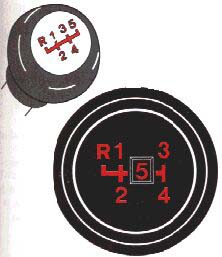
Gear lever
pg. 53 Manual transmission + overdrive |
Gear lever
Depress the clutch fully when shifting gears, and when engaging/disengaging overdrive (5th gear).
Remove foot from the clutch pedal after shifting.
Overdrive (5th gear)
The overdrive can be engaged in 4th gear only. The overdrive is engaged/disengaged by depressing the switch on top of the gear shift lever.
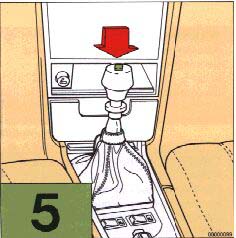
The overdrive is automatically disengaged when downshifting from 4th gear, but you should
always
disengage the overdrive
manually
before downshifting. To improve mileage it is recommended to use the overdrive as much as possible at speeds above 45 mph (70 km/h).
The green control light "5" on the dashboard lights when the overdrive is engaged. See "Shift indicator light" section for more information on economical use of the manual transmission.
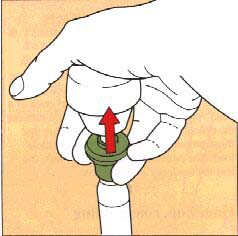
Reverse gear
The detent collar on the gear lever must be lifted prior to engaging reverse gear. This prevents unintentional selection of the gear.
Weight distribution affects handling
At the specified curb weight your car has a tendency to understeer, which means that the steering wheel has to be turned more than might seem appropriate for the curvature of a bend. This ensures good stability and reduces the risk of rear wheel skid. Remember that these properties can alter with the vehicle load. The heavier the load in the trunk, the less the tendency to understeer.
Handling, roadholding
Vehicle load, tire design, and inflation pressure, all affect vehicle handling. Therefore, check that the tires are inflated to the recommended pressure according to the vehicle load. See "Tire pressure" section. Loads should be distributed so that capacity weight or maximum permissible axle loads are not exceeded.
WARNING! It is recommended that tire of the same make and dimensions be used on all four wheels. Do not use bias ply tires as this will adversely alter vehicle handling characteristics. |
WARNING!
|
CAUTION: Driving through standing water
|
WARNING! Do not drive with trunk lid or tailgate open!
|
Roof racks (removable and permanent)
Roof rails are available as Volvo accessories. Observe the following points when is use:
∙ Avoid single-point loads. Distribute the load evenly.
∙ Place heavier cargo at bottom of load.
∙ Observe that center of gravity and handling are influenced by load weight.
∙ Increasing load size increases wind resistance and, thus, adversely affects fuel economy.
∙ Anchor the cargo correctly with a cord.
∙ Drive carefully. Avoid rapid starts, fast cornering and hard braking.
∙ Max. roof load is 220 lbs. (100 kg) for removable racks mounted on drip rails.
∙ Max. roof load is 70 lbs (30 kg) for permanent rack mounted directly on roof.
pg. 55 Points to remember (cont.) |
Cooling system
The risk for overheating is greatest, especially in hot weather, when:
∙ towing a trailer up steep inclines for prolonged periods at wide open throttle and low engine rpm.
∙ idling for prolonged periods while the air conditioning is in operation.
∙ stopping the engine suddenly after high speed driving (so-called "after-boiling" can occur).
To avoid overheating, the following rules should be followed:
∙ Reduce speed and downshift when towing a trailer up long, steep inclines. The risk of overheating can be reduced by switching off the air conditioning system for a short time.
∙ Do not let the engine idle unnecessarily for prolonged periods.
∙ Do not stop the engine immediately after high-speed driving, but instead, allow the engine to idle for 1/2-1 minute before
switching off.
When the risk of overheating is imminent, or in the event of overheating, (the temperature gauge goes repeatedly into, or stays continually in, the red section) the following precautions should be taken:
∙ Switch off the air conditioning system.
∙ Stop the car and put the gear lever into neutral (position N).
Do not stop the engine!
∙ Increase the engine speed to approx. 2000 rpm (twice idling speed)
∙ If the vehicle is overheating, switch the heater to full (maximum) position.
Electrical system
When replacing the battery or when carrying out work involving the electrical system, the following should be observed:
∙ A battery connection to the wrong terminal will damage the diodes. Before connections are made, check the polarity of the
battery with a voltmeter.
∙ If booster batteries are used for starting, they must be properly connected to minimize the risk of the diode being damaged.
For correct connection, see "Jump starting" section.
∙ Never disconnect the battery circuit (for example, to replace the battery) while the engine is running, as this will immediately
ruin the generator. Always make sure that all the battery connections are properly tightened.
∙ If any electrical/welding work is performed on the vehicle, the battery's ground lead (negative cable) and all the connecting
cables of the generator must be disconnected and the welder cables placed as near the welding point as possible.
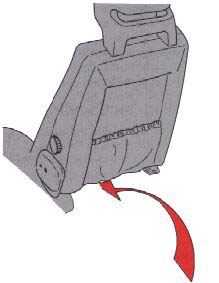
WARNING!
|
Economical driving does not necessarily mean driving slowly
Better driving economy may be obtained by thinking ahead, avoiding rapid starts and stops and adjusting the speed of your vehicle to immediate traffic conditions. Observe the following rules:
∙ Bring the engine to normal operating temperature as soon as possible by driving with a light foot on the accelerator pedal
for the first minutes of operation. A cold engine uses more fuel and is subject to increased wear.
∙ Whenever possible, avoid using the car for driving short distances. This does not allow the engine to reach normal
operating temperature.
∙ Drive carefully and avoid rapid acceleration and hard braking.
∙ Do not exceed speed limit.
∙ Avoid carrying unnecessary items (extra load) in the car.
∙ Check tire pressure regularly (check when tires are cold).
∙ Remove snow tires when threat of snow or ice has ended.
∙ Note that roof racks, ski racks, etc., increase air resistance and thereby fuel consumption.
∙ Turbo: try to keep the boost pressure gauge in the black range.
∙ Utilize overdrive at speeds above approx. 45 mph (70 km/h)
∙ Avoid using automatic transmission kick-down feature unless necessary.
∙ On cars with manual transmission, utilize the shift indicator light (S.I.L.). See "Instruments".
Other factors which decrease gas mileage are:
∙ Worn or dirty spark plugs
∙ Incorrect spark plug gap
∙ Dirty air filter
∙ Incorrect valve clearance
∙ Dirty engine oil and clogged oil filter
∙ Dragging brakes
∙ Incorrect front end alignment
∙ Low tire pressure
Some of the above mentioned items and others are checked at the standard Maintenance Service intervals.
Carbon deposit build-up
Your engine has been designed for peak performance and smooth operation. The fuel you use plays a major role on how your engine will function. With the many variations of fuel available, it is important that detergent blend fuels be used to reduce the risk of intake valve carbon deposit build-up and clogged fuel injectors. Both of these conditions will rob your engine of the very thing it has been designed for, performance and smooth operation.
Note:
|


 and fan control to its highest setting.