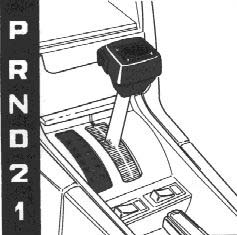
Gear selector positions
pg. 49 Automatic transmission (cont.) |
Starting and stopping a car equipped with automatic transmission
1 Fasten the seat belt.
WARNING! Before starting, check that the seat is adjusted properly. Make sure the brake/- clutch pedal can be depressed completely. Move the seat closer if necessary. |
2 Apply the parking brake and press the brake pedal firmly to hold the car (to prevent it from moving when the gear selector is moved).
3 Select position P or N. (engine cannot be started in any other position.)
4 Start the engine by turning the starting (ignition) key.
5 Select desired gear. The gear engages with a slight delay, especially noticed in R.
Engine should be idling; never accelerate until you feel the gear is engaged!
Too rapid acceleration immediately after selecting gears will provide harsh engagement and premature transmission wear.
6 Release the brakes and accelerate.
To stop the car
, release the accelerator pedal and apply the brakes.
Selecting position N when standing still with engine running for prolonged periods of time will avoid overheating transmission fluid.
The following "Special Tips" apply to cars with automatic transmission
∙ For steep hills and when driving for prolonged periods at low speed position 1should be selected. Avoid, however, repeated changes since this can cause overheating of the transmission oil. For driving on mountain roads with long persistent uphill gradients, select position 2.
∙ When negotiating long, steep downhill slopes, position 1 or 2 should be selected, in order to obtain the best possible engine braking effect.
∙ Do not hold the car stationary on an incline by using the accelerator pedal; instead, engage the parking brake. This prevents unnecessary heating of the transmission oil.
∙ When towing, prepare as follows:
Disengage the 4th gear (the indicator light on the instrument panel goes on).
WARNING!
|
Gear selector positions
P park
R reverse
N neutral
D drive
2 intermediate
1 low
P (Park)
Use this position when starting the engine or parking the vehicle.
Never use P while car is in motion.
The transmission is mechanically locked when in position P. Also, apply the parking brake when parking on grades.
The gear selector is locked in the Park position - SHIFT-LOCK. To release the selector, the ignition must be switched on and the brake pedal must be depressed. Manually releasing see page 6:18.
WARNING!
|
R (Reverse)
Never engage R while is moving forward.
N (Neutral)
Neutral position = no gear is engaged. Use parking brake. The car can also be started in this position.
Driving gears
D (Drive)
D is the normal driving position. Upshifts and downshifts of the forward gears occur automatically and are governed by accelerator pedal position and vehicle speed.
Lock-up (certain models)
With the gear selector in position D (Drive) the lockup device disengages the torque converter at speeds above approx. 47-56 mph (75-90 km/h). It provides lowered engine speeds and improved mileage.
The lockup engagement may be noticed as an extra upshift when accelerating.
pg. 51 Automatic transmission (cont.) |
2 (intermediate position)
Upshifts and downshifts of first two gears (low and intermediate) occur automatically. No upshift to 3rd or 4th gear occurs. Position 2 may be used to obtain forced downshift to 2nd gear for increased engine braking effect.
1 (low position)
If position 1 is selected when driving at high speeds, 2 is engaged first and 1 when the speed has dropped to approx. 30 mph (50 km/h). No upshift can occur once 1 is engaged. Use position 1 to select low gear when no upshift is desired, for instance, when entering and descending steep grades.
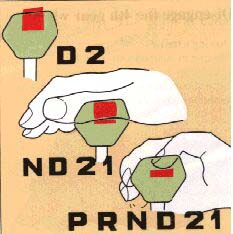
Shift gate
The gear selector can be moved freely between D and 2. Selections of other positions are obtained by depressing the selector knob prior to moving the selector.
Slightly depressing the selector knob allows selection of positions N, D, 2 and 1.
Fully depressing the selector knob allows selection of positions R and P. This is also necessary when initially bringing the selector out of position P.
Fully depressing the selector knob thus permits shifting freely between all positions.
pg. 52 Automatic transmission (cont.) |
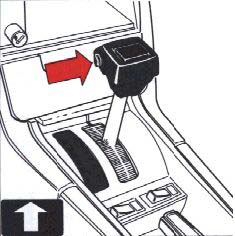
4th gear disengagement:
The 4th gear is engaged automatically after the transmission has shifted through 1st, 2nd and 3rd gears at certain speeds and loads. By pressing in the button at the rear of the selector level, the 4th gear can be disengaged, thus providing a three-speed transmission. As a reminder the И light on the dashboard glows. By pressing in the button again, the transmission reverts to four-speed operation and the И light shuts off.
Disengage the 4th gear when:
- towing a trailer
- driving in mountainous regions.
Since using the 4th gear improves fuel economy, it should be used as often as possible in conditions other than those stated above.
WARNING!
|
Kick-down
Automatic shift to a lower gear (kick-down) is achieved by depressing the accelerator pedal fully and briskly. An up-shift will be achieved when approaching the top speed for a particular gear or by releasing the accelerator pedal slightly. Kick-down can be used for maximum acceleration or when passing at highway speeds below a certain limit.
NOTE: The kickdown feature should not be used during the break-in period. |

