Child safety
Volvo recommends the proper use of restraint systems for all occupants including children. Remember that, regardless of age and size, a child should always be properly restrained in a car.
Restraint systems for children are designed to be secured in the vehicle by lap belts or the lap portion of a lap-shoulder belt. Such child restraint systems can help protect children in cars in the event of an accident only if they are used properly. However, children could be endangered in a crash if the child restraints are not properly secured in the vehicle. Failure to follow the installation instructions for your child restraint can result in your child striking the vehicle's interior in a sudden stop.
Holding a child in your arms is NOT a suitable substitute for a child restraint system. In an accident, a child held in a person's arms can be crushed between the vehicle's interior and an unrestrained person. The child could also be injured by striking the interior, or by being ejected from the vehicle during a sudden maneuver or impact. The same can also happen if the infant or child rides unrestrained on the seat. Other occupants should also be properly restrained to help reduce the chance of injuries or increasing the injury of a child.
All states and provinces have legislation governing how and where children should be carried in car. Find out the regulations existing in your state or province. Recent accident statistics have shown that children are safer in rear seating positions than front seating positions when properly restrained. A child restraint system can help protect a child in a vehicle. Here's what to look for when selecting a child restraint system:
∙ It should have a label certifying that it meets applicable Federal Motor Vehicle Safety Standards (FMVSS 213-80) - or in Canada, CMVSS 213.
∙ Make sure the child restraint system is approved for the child's height, weight and development - the label required by the standard or regulation, or instructions for infant restraints, typically provide this information.
∙
In using any child restraint system, we urge you to look carefully over the instructions that are provided with the restraint. Be sure you understand them and can use the device properly and safely in this vehicle. A misused child restraint system can result in increased injuries for both the infant or child and other occupants in the vehicle.
∙ If your child restraint requires a top tether strap, consult your authorized Volvo dealer for top tether anchorage and installation information.
When a child has outgrown the child safety seat (approximately age 4-5 years, depending on size) you should use the rear seat with the standard seat belt fastened. The best way to help protect the child here is to place the child on a cushion so that the seat belt is properly located on the hips.
A specially designed and tested safety cushion for this purpose can be obtained from your Volvo dealer.
If necessary, an extra seat is available for use in the luggage compartment of station wagon models. This seat is designed for two children, each up to 88 lbs. and up to 53 inches in height.
pg. 31 Child Safety |
Child Restraint Anchorages
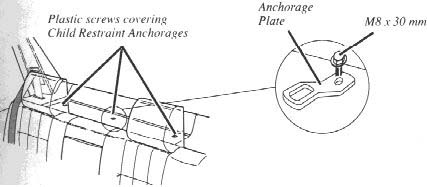
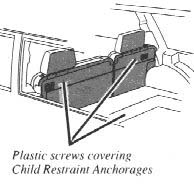
Volvo cars are fitted with Child Restraint Top Tether Anchorages in the rear seat. There are three anchorages under the rear section of the car's rear window shelf on sedans and on the back rest on wagons. The backrest on wagons must be folded down slightly to reach the anchorages. When the car is delivered, the holes for these anchorages are covered by plastic covers. In cars designated for Canada, one top tether anchorage set will be in the glove box.
The top tether anchorage set includes the top tether anchorage plate, an M8 bolt 30 mm (1.18") long and a plastic trim cover.
If another set is needed, consult your Volvo dealer.
Installing the top tether
Remove the plastic cover on the anchorage point you want to use. This can be done with a suitable coin. The screw is removed counter-clockwise. Place the top tether anchorage plate as shown in the illustration. Using the 5/16" x 30 UNC bolt, tighten securely, to 16+/- 2.5 ft-lb. Place the plastic trim plate over the anchorage plate, if desired.
WARNING!
Child Restraint Anchorages are designed to withstand only those loads imposed by correctly fitted Child Restraints. Under no circumstances are they to be used for adult seat belts or harnesses.
The anchorages are not able to withstand excessive forces on them in the event of collision if full harness seat belts or adult seat belts are installed to them. An adult who uses a belt anchored in a Child Restraint Anchorage runs a great risk of suffering severe injuries should a collision occur.
Seat belts

Always fasten the seat belts before you drive or ride.
Two lights above the rear view mirror will be illuminated for 4-8 seconds after the starting (ignition) key is turned to the driving position. One light is located in the instrument panel and one in the console between the front seats.
A chime will sound at the same time if the driver has not fastened his seat belt. The rear seats are provided with self-retracting inertia reel belts. The front seats are provided with twin roller belts.
To buckle:
Pull the belt out far enough to insert the latch plate into the receptacle (buckle for rear seats) until a distinct snapping sound is heard. The seat belt retractor is normally "unlocked" and you can move freely, provided that the shoulder belt is not pulled out too far. The retractor will lock up as follows:
∙ if the belt is pulled out rapidly
∙ during braking and acceleration
∙ if the vehicle is leaning excessively
∙ when driving in turns
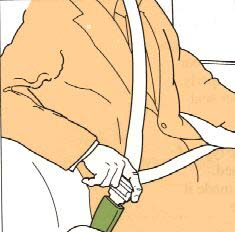
In order for the seat belt to provide maximum protection in the event of an accident, it must be worn correctly. When wearing remember:
∙ The belt should not be twisted or turned.
∙ The lap belt must be positioned low on the hips (not pressing against the abdomen). Make sure that the shoulder belt is rolled up into its retractor and that the shoulder and lap belts are taut.
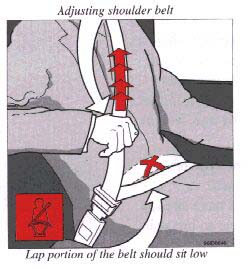
Before exiting the car, check that the seat belt retracts fully after being unbuckled. If necessary, guide the belt back into the retractor slot.
WARNING! Any device used to induce slack into the shoulder belt portion of the three-point belt system will have a detrimental effect on the amount of protection available to you in the event of a collision. |
pg. 33 Seat belts (cont.) |
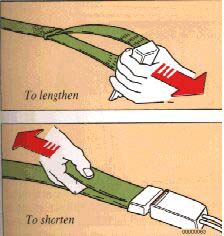
Center-rear belt adjustment
The center-rear seat belt is manually adjustable. It should always be adjusted to fit snugly across the lap.
To unfasten
Depress red pushbutton in receptacle (buckle) and let the belts rewind into their retractors.
Maintenance
Check periodically that the anchor bolts are secure and that the belts are in good condition.
Use water and a mild detergent for cleaning.
Check seat belt mechanism function as follows:
1. Attach the seat belt. Pull rapidly on the strap.
WARNING! Check other traffic before performing the following check. |
2. Brake firmly from approximately 30 mph (50 km/h) or turn in a tight circle while pulling on the belt.
In the above checks you should not be able to pull the belt out.
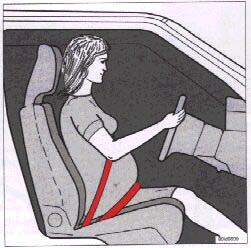
During pregnancy
Pregnant women should always wear seat belts. Remember that the belt should always be positioned in such a way as to avoid any possible pressure on the abdomen. The lap portion of the belt should be located low, as shown in the above illustration.
NOTE:
|
WARNING! Never use a seat belt for more than one occupant.
|
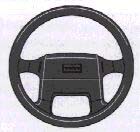
Volvo SRS
As an enhancement to the three-point seat belt system, your Volvo is equipped with a Supplemental Restraint System (SRS). The Volvo SRS consists of a driver's side airbag with a driver's side knee bolster. The system is designed to supplement the protection provided by the three-point seat belt system.
The interior of an SRS-equipped Volvo looks very much the same as any other. The only indications of the system's presence are the "SRS" embossed on the steering wheel pad, and the knee bolster beneath the steering column.
The airbag is folded and located in the center of the steering wheel. It is released only during certain frontal or front-angular collisions in which the forces sustained by the car are equivalent to an impact into a rigid barrier of approximately 12 mph (19 kph).
WARNING!
|
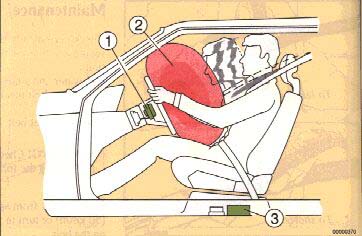
The airbag system includes a gas generator (1) surrounded by the airbag itself (2). In the event of a frontal or certain front-angular collisions equivalent to impacting a rigid barrier of approximately 12 mph (19kph), the sensor (3) activates the gas generators causing the airbags to be inflated with nitrogen gas. As the movement of the driver compresses the airbag some of the gas is expelled at a controlled rate to provide better cushioning.
The entire process, including inflation and deflation of the airbags, takes approximately two-tenths of a second.
WARNING!
|
pg. 35 Supplemental Restraint System |
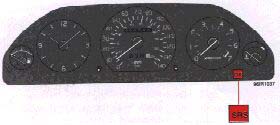
A self-diagnostic system incorporated in the sensor monitors the SRS. If a fault is detected, the "SRS" warning light will illuminate. The light is included in the warning/indicator light cluster in the instrument panel. Normally, the SRS warning lamp will be illuminated along with the other warning/indicator lights when the ignition key is turned to the ON position (position II), and go out a short time after the engine has been started. Check that this light is functioning properly every time the car is started.
The following items are monitored by the diagnostic system:
∙ Sensor unit electronics integrity
∙ Reserve energy supply
∙ Diagnostic output circuit
∙ System voltage
∙ Integrity of system connectors
∙ Mercury switch closure
∙ Gas generator ignitor
WARNING! If the SRS warning light stays on after the engine has started or if it comes on while you are driving, drive the car to the nearest authorized Volvo Dealer for inspection as soon as possible. |
ATTENTION! SRS VEHICLE!
|
This decal can be found in the center console.
There is no maintenance to perform on the SRS yourself. The only periodic maintenance recommended on the SRS is that the air bag module and the sensor unit should be replaced approximately every ten years and that the other components in the system (wiring, connectors, etc.) should also be inspected at this time. This service must be performed by an authorized Volvo dealer.
Should you have any questions about the SRS system, please contact your authorized Volvo Dealer or Consumer Affairs Department:
In the U.S.A.:
Volvo Cars of North America
One Volvo Drive,
Rockleigh, New Jersey 07647
In Canada:
Volvo Canada Ltd.
175 Gordon Baker Road
Willowdale, Ontario M2H2N7

